
Blog E-Commerce 07/28/2026 11 min read
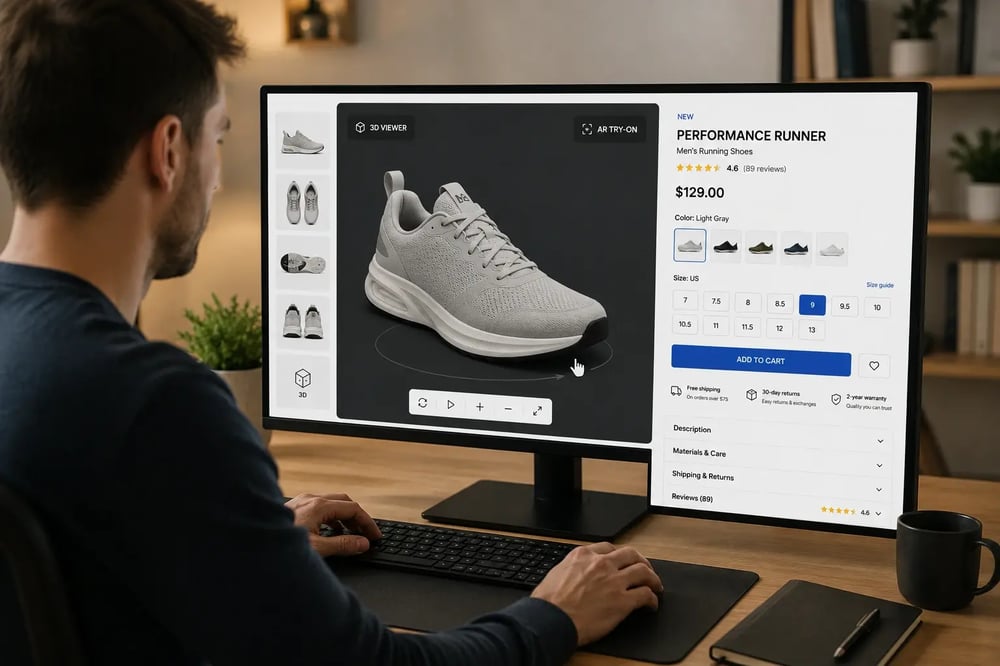
Footwear e-commerce SEO is changing as product pages become more visual, interactive, and data-rich. For shoe brands and retailers, 3D visualization and AR are not only experience features. They can also support product discovery, search visibility, and buyer confidence when implemented correctly.
This article explains how to optimize 3D and AR product pages for search, usability, and ecommerce performance.
Why 3D and AR Change Footwear Product Page SEO
Traditional footwear product pages rely on titles, descriptions, images, size charts, reviews, and product attributes. These elements still matter. But 3D and AR add a new layer of product information that can help shoppers understand shape, material, volume, color, and style from more angles.
For SEO teams, this creates a practical challenge. Search engines need clear page signals, while shoppers need a smooth interactive experience. A 3D model or virtual try-on feature will not improve performance by itself if the page lacks crawlable content, structured data, fast loading, and useful product details.
Google states that product structured data can help product information appear in richer ways across Search, Google Images, and Google Lens. This includes details such as price, availability, reviews, shipping, and return information. For footwear ecommerce teams, this means product page SEO should connect visual assets with structured product data.
The opportunity is simple. A well-optimized 3D or AR product page can serve both search engines and shoppers. It can help users find the right shoe, evaluate it faster, and move toward purchase with more confidence.
The Core SEO Elements of a 3D and AR Product Page
A 3D or AR footwear product page needs the same SEO foundation as any strong ecommerce page. The difference is that every interactive asset should support the product story, with crawlable content, structured data, useful copy, internal links, and fast loading.
Search-aligned product titles and descriptions that match buyer intent
The product title should be clear, specific, and aligned with how customers search. A strong footwear title usually includes the brand, model, category, audience when relevant, and defining attributes such as color or material.
Product descriptions should explain what shoppers can see, compare, and evaluate through the 3D or AR experience. If a 3D viewer lets users inspect the sole, stitching, heel shape, or upper texture, the copy should mention these details naturally.
This supports both SEO and conversion because the page gives search engines richer context and gives shoppers more useful buying information. The goal is to describe the product in a way that matches real evaluation behavior.
Structured product data that helps search engines understand each shoe
Structured data is essential for ecommerce SEO because it gives search engines a clearer technical description of the product. Google recommends Product markup for product pages and merchant listing structured data for pages where users can buy directly.
For footwear, structured data should include accurate product information such as:
- Product name
- Brand
- Images
- Price
- Availability
- Color
- Size information
- Reviews when available
- Shipping and return details
Product variant structured data is also important when the same shoe exists in multiple colors, sizes, or materials. It helps Google understand the relationship between variations instead of treating every page as disconnected or duplicate content.
Optimized visual assets that protect speed and product clarity
3D and AR content should be optimized for user experience and technical performance. Large assets can slow down product pages if they are not compressed, loaded efficiently, or supported by fallback images.
Google Manufacturer Center notes that 3D models let shoppers view products from every angle and zoom in on details. For footwear teams, this means interactive assets should be treated as performance assets, not only visual enhancements.
Each visual asset should have a clear role. Use 3D for shape, proportions, and detail inspection. Use AR or virtual try-on to help shoppers imagine the shoe in context. Use standard images for fast scanning and accessibility.
Alt text should describe the visible product accurately without keyword stuffing. A useful example would be: “White leather low-top sneaker shown in side view with textured rubber sole.”
Internal links that connect product discovery with useful context
Internal links help users and search engines understand how content connects across your site. On footwear product pages, they can guide shoppers to educational pages, category pages, size guides, care guides, and technology explanations.
For example, a footwear brand explaining how it creates digital assets can link to a page about 3D shoe digitization. A retailer highlighting interactive product viewing can link to a page about a 3D viewer for shoes. A product page focused on try-on confidence can link to a page about virtual try-on of shoes.
The rule is relevance. Internal links should help shoppers understand the product experience, technology, or buying process. They should not be forced into the page only for SEO.
How 3D and AR Improve Ecommerce Signals
Search performance is not only about rankings. It also depends on the quality of the experience after the click. If users land on a product page and quickly leave because they cannot understand the shoe, that page has a business problem.
3D and AR can support better ecommerce signals by improving product comprehension. When shoppers can rotate a shoe, zoom into details, or digitally try it on, they can answer practical questions faster.
These questions often include:
- Does the shoe shape match my style?
- How thick is the sole?
- What does the upper texture look like?
- Does the color look different from another angle?
- Can I imagine wearing this shoe with my outfits?
Baymard’s ecommerce UX research is based on large-scale testing across thousands of users and ecommerce examples. Its research consistently highlights the importance of strong product page usability, clear product information, and confidence-building details in online buying journeys.
For footwear brands, these usability principles matter because shoes involve visual, emotional, and practical evaluation. The shopper is not only choosing a product. They are evaluating style, fit expectations, comfort signals, and return risk.
Footwear-Specific Optimization Opportunities
Footwear product pages have unique SEO and UX needs because shoppers evaluate shoes through style, fit expectations, material details, and practical use cases. A shopper buying sneakers, boots, sandals, heels, or performance shoes needs more than a product name and a front-view image.
Visual detail optimization for shape, materials, and construction
3D visualization is especially useful for footwear because shoes have complex shapes. The side profile, toe box, sole thickness, heel structure, stitching, laces, and material finish all influence purchase decisions.
Your copy should support what shoppers can inspect through the 3D experience. Instead of writing only “premium sneaker with modern design,” mention the upper material, outsole design, closure type, texture, silhouette, or construction details when they matter.
This creates more useful content for shoppers and more semantic relevance for search engines. The shopper can read a detail, inspect it visually, and make a more confident decision.
Fit and size content that works with interactive product experiences
3D and AR should not replace size information. They should complement it by helping shoppers evaluate appearance, proportions, and style before they buy. Shoppers still need clear size guidance, fit notes, and return information.
Product pages should connect visual exploration with practical fit information. A running shoe page can explain whether the model has a narrow profile, padded collar, high-stack sole, or wide toe box. A fashion boot page can clarify shaft height, heel height, and calf fit.
This reduces uncertainty because footwear shoppers often hesitate when they cannot judge fit, shape, or proportion. When visual content and fit guidance work together, the product page becomes more useful for discovery and conversion.
Omnichannel product content that supports online and store journeys
3D and AR product content can support omnichannel retail. A shopper may discover a shoe online, inspect it in 3D, save it, visit a store, or complete the purchase later on mobile.
For SEO, this means product pages should include consistent data across ecommerce pages, product feeds, store availability, and local experiences when relevant. Consistent information helps search engines and shoppers understand product attributes and buying options.
This is especially useful for footwear retailers with ecommerce and physical stores, where product discovery often starts online but may continue in-store.
Common SEO Mistakes on 3D and AR Product Pages
Many footwear brands invest in 3D or AR but do not adapt their SEO strategy around the experience. This limits the value of the page because the interactive feature may be strong while the surrounding content remains thin, slow, or unclear.
Using 3D as a visual feature without supporting product content
3D content should not be hidden inside a page with thin copy and missing product attributes. If the page does not explain what the user can evaluate, the experience may feel impressive but incomplete.
Use the 3D viewer as part of the product story. Describe key visual details, link to relevant guides, and make sure the interactive asset supports the buying decision. If the viewer highlights sole thickness or material texture, the page copy should support that discovery.
This gives search engines more product context and helps shoppers understand the value of the interactive experience.
Adding heavy interactive assets without protecting page performance
Slow product pages can hurt both user experience and ecommerce performance. Large 3D files, scripts, and AR assets should be implemented carefully so they do not delay access to product names, images, prices, size options, and key details.
Use lazy loading, compression, fallback images, and clear HTML content that remains accessible even if the interactive feature does not load. A product page should not depend entirely on a script or visual asset to communicate its main information.
The goal is to create an interactive page that feels useful, fast, and reliable. 3D and AR should enhance the product experience, not slow it down.
Repeating generic copy across footwear variants and collections
Footwear catalogs often include many variants, which makes duplicated copy a common issue. Reusing the same description across colors, materials, or collections creates weaker product pages and misses SEO opportunities.
When a variant has a meaningful difference, describe it clearly. A suede version, reflective finish, platform sole, waterproof upper, limited colorway, or different outsole may deserve unique copy.
This is especially important when 3D or AR makes those differences visible. If shoppers can rotate the product and see a material, shape, or construction difference, the written content should support that visual discovery.
Practical SEO Checklist for Footwear Teams
Use this checklist before launching or updating 3D and AR footwear product pages.
| SEO area | What to check | Business value |
|---|---|---|
| Product copy | Clear title, useful description, material and fit details | Improves relevance and buyer confidence |
| Structured data | Product, Offer, availability, price, reviews, variants | Supports richer product visibility |
| 3D assets | Compressed model, fallback image, fast loading | Protects page speed and engagement |
| AR experience | Clear entry point, mobile usability, try-on guidance | Reduces hesitation and supports conversion |
| Internal links | Relevant links to guides, technology pages, categories | Improves discovery and context |
| Analytics | Track 3D views, AR launches, add-to-cart, returns | Connects SEO work to ROI |
The strongest SEO strategies connect technical optimization with real shopper behavior. Track how users interact with 3D viewers, AR features, size content, image galleries, and product details. Then compare those signals with conversion rate, return rate, and assisted revenue.
This helps ecommerce teams move from “we added 3D” to “we know how 3D affects discovery, engagement, and sales.”

Conclusion
Footwear e-commerce SEO for 3D and AR product pages requires more than adding interactive visuals. The strongest pages combine structured data, fast performance, useful copy, accessible assets, and clear buying information.
For footwear brands and retailers, the goal is practical. Help search engines understand the product, help shoppers evaluate it with confidence, and turn visual engagement into measurable ecommerce value.
Frequently Asked Questions
Does 3D content directly improve footwear SEO rankings?
3D content does not automatically improve rankings. Its SEO value comes from better product information, stronger engagement, structured data, and improved user experience. To make it effective, combine 3D assets with crawlable copy, optimized media, product schema, and clear buying details.
What structured data should footwear product pages include?
Footwear product pages should include Product and Offer structured data, with accurate information for price, availability, brand, images, reviews, color, size, shipping, and returns. Product variant markup is also useful when one shoe model has multiple sizes, colors, or materials.
How can AR product pages reduce hesitation before purchase?
AR helps shoppers visualize how a shoe looks in context, especially on mobile. It can support confidence around style, shape, and proportions. For best results, pair AR with clear size guidance, fit notes, product images, material details, and return information.
Should every footwear product page include 3D or AR?
Not always. Start with products where visual evaluation matters most, such as new launches, best sellers, premium collections, or products with complex details. Measure engagement, add-to-cart rate, conversion, and returns before expanding 3D or AR across the full catalog.
Sources
- Introduction to Product Structured Data (2025) https://developers.google.com/search/docs/appearance/structured-data/product
- Merchant Listing Product and Offer Structured Data (2025) https://developers.google.com/search/docs/appearance/structured-data/merchant-listing
- Display Your Products in 3D and Augmented Reality (2025) https://support.google.com/manufacturers/answer/13003911?hl=en
- Latest UX Research and Ecommerce Design Data (2026) https://baymard.com/research
- 3D Reconstruction of Shoes for Augmented Reality (2025) https://arxiv.org/abs/2501.18643

Fittingbox Footwear
Fittingbox Footwear is a dedicated business unit of Fittingbox, specialized in 3D and augmented reality solutions for the footwear industry. It offers ultrarealistic 3D digitization, immersive virtual try-on, and flexible integration — ranging from plug-and-play tools to fully customizable implementations.