
Link Building Strategies for AR Footwear Experiences
Blog E-Commerce 08/11/2026 10 min read
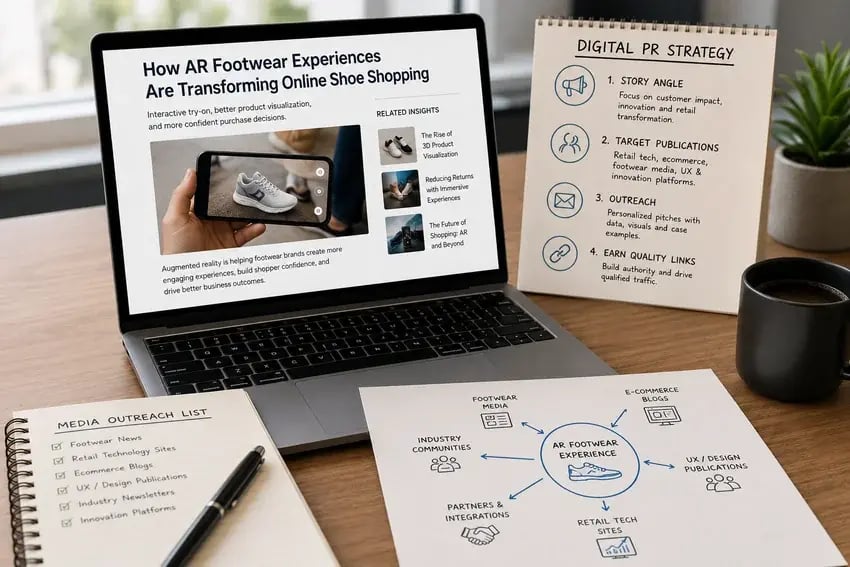
AR footwear experiences can make online shoe shopping more interactive, but visibility does not happen automatically. To attract qualified traffic, footwear brands need more than optimized product pages. They need credible links from relevant sources. A strong link building strategy helps search engines and buyers understand why your AR content deserves attention.
🔑 Key Takeaways
- Relevant backlinks support AR visibility by helping search engines connect footwear content with ecommerce intent.
- Educational assets earn stronger links than commercial pages because they give publishers useful context to cite.
- Digital PR works best when AR is tied to customer confidence, product discovery, and retail innovation.
- Internal links strengthen topic clusters by connecting parent SEO content with AR, 3D, and virtual try-on pages.
- Measure link quality beyond volume using referral engagement, assisted conversions, AR interactions, and keyword growth.
Why AR footwear experiences need link building
AR footwear experiences sit at the intersection of ecommerce, product visualization, customer experience, and retail innovation. That makes them valuable for shoppers, but also complex for search engines to classify.
Link building helps create context. When relevant websites link to your AR shoe experience, they signal that your content is useful beyond your own domain. This can support organic visibility, referral traffic, and brand authority.
For footwear brands, this matters because AR content often supports high-intent moments. A shopper may be comparing styles, checking proportions, or deciding whether a sneaker fits their look. Better discovery can bring more qualified visitors to these experiences.
AR content creates value beyond a product page
A standard product page usually focuses on price, sizes, colors, and delivery. An AR footwear experience can do more. It can show how a shoe looks from different angles, how it appears on foot, and how design details change perception.
This makes the content useful for audiences outside direct buyers. Ecommerce teams, UX specialists, retail journalists, technology analysts, and merchandising professionals may all reference strong AR examples.
Backlinks help search engines understand topical authority
Search engines use links as one signal to understand relevance and authority. For AR footwear pages, backlinks from ecommerce, retail technology, fashion innovation, and UX publications can help build topical depth.
The goal is not to collect random links. The goal is to earn links from pages that make sense in context. A link from an article about digital merchandising is more useful than a link from an unrelated directory.
Build linkable assets around AR and 3D footwear content
Most websites do not link to commercial pages without a strong reason. That is why AR footwear link building should start with assets that educate, inform, or demonstrate something useful.
These assets can live inside your SEO cluster and support your parent article, product pages, and related resources.
Data-led guides
Data-led guides are useful because they give other websites something concrete to reference. For example, a footwear brand could publish a guide on how AR product visualization affects product confidence, time on page, or customer engagement.
You do not need to reveal sensitive business data. You can combine anonymized internal insights, customer behavior trends, survey results, or publicly available ecommerce research.
Useful formats include:
- Benchmark reports on AR engagement across footwear categories
- Guides comparing static images, 3D viewers, and AR try-on
- Research summaries on product visualization and online returns
- Checklists for launching AR footwear experiences
These resources are easier to pitch because they help publishers add substance to their own articles.
Interactive demonstrations
AR is visual by nature. A clear demonstration can become a linkable asset when it shows a practical use case. This could be a landing page where visitors can see how a shoe moves from 2D images to 3D visualization and then to AR try-on.
Interactive content works especially well when it explains the user journey. Instead of saying that AR improves engagement, show how the shopper interacts with the product before purchase.
For example, a footwear retailer could create a page that compares three experiences:
| Experience type | Customer value | Best link angle |
|---|---|---|
| Static product images | Basic product discovery | Product page optimization |
| 3D product viewer | Better inspection of shape and details | Digital merchandising |
| AR shoe try-on | More contextual visualization | Customer experience innovation |
Educational explainers
Many buyers understand AR as a feature, but not as an ecommerce system. Educational content can explain how AR footwear experiences depend on 3D assets, product data, mobile compatibility, and page performance.
This type of content can attract links from technology blogs, ecommerce consultants, and digital transformation publications.
A useful explainer might cover how 3D shoe digitization supports product visualization at scale. Another could explain how a 3D viewer of shoes helps shoppers inspect design details before moving to AR.
Comparison content
Comparison content performs well because it matches practical decision-making. Footwear teams often compare AR with product videos, 360-degree images, size guides, or traditional product photography.
Potential comparison topics include:
- AR shoe try-on vs 360-degree product images
- 3D footwear visualization vs product video
- Virtual shoe fitting vs standard size guides
- Product visualization tools for footwear ecommerce
These articles can earn links because they help teams evaluate options without pushing a single solution.
Use digital PR to connect AR with footwear business outcomes
Digital PR works best when the story is bigger than the product. For AR footwear experiences, the strongest stories usually connect technology to customer experience, confidence, returns, or retail transformation.
Recent retail discussions continue to focus on the high cost of ecommerce returns. This gives AR and product visualization a relevant business context, especially when the experience helps shoppers make more informed purchase decisions.
Pitch customer experience stories
Journalists and industry editors are more likely to cover AR when it reflects a clear customer shift. A pitch should not say, “We launched AR.” It should explain what the AR experience changes for the shopper.
For example:
- How shoppers inspect sneaker details before purchase
- How mobile product visualization supports discovery
- How AR bridges product pages and in-store confidence
- How footwear brands adapt ecommerce UX for visual decision-making
This makes the story more useful for publications covering ecommerce, retail innovation, and digital customer experience.
Focus on return reduction and product confidence
Footwear returns are often connected to uncertainty around fit, appearance, color, proportions, and expectations. AR does not solve every return reason, but it can help reduce visual uncertainty before checkout.
That angle can support link building. Content about return prevention, pre-purchase confidence, and better product visualization is relevant to ecommerce leaders and operations teams.
Use careful language. Avoid promising that AR will automatically reduce returns. Instead, explain how AR can support better-informed decisions when combined with accurate product data, size guidance, and clear merchandising.
Connect AR to retail innovation
AR footwear experiences also fit broader stories about omnichannel retail. A shopper may discover a shoe online, visualize it on mobile, visit a store, and complete the purchase later.
This creates link opportunities with publications that cover retail transformation, mobile commerce, and store-to-digital journeys.
For example, an article about virtual try-on of shoes can support a broader discussion about how brands bring product experience closer to the shopper before purchase.
Partner with relevant industry publishers and communities
Effective link building depends on relevance. A smaller number of strong links from qualified websites can be more valuable than a large number of weak links.
For AR footwear experiences, the best targets usually sit across four groups.
Footwear trade media
Footwear trade publications care about product innovation, brand strategy, merchandising, and retail performance. They may be interested in AR stories when the angle connects to market evolution or customer behavior.
Good outreach topics include new product visualization formats, digital merchandising workflows, and the role of AR in online footwear discovery.
Ecommerce and retail technology publications
These publishers often cover practical technologies that improve conversion, engagement, and customer experience. AR footwear pages can fit naturally when the article explains implementation, measurement, or business impact.
Useful content formats include expert commentary, contributed articles, case-study summaries, and trend analysis.
UX and digital merchandising communities
UX teams care about how shoppers evaluate products. Digital merchandising teams care about how content influences product discovery and confidence.
AR footwear experiences can appeal to both audiences. Linkable content should explain interface choices, mobile usability, product page structure, and the role of interactive media in decision-making.
Partner and technology ecosystems
Brands can also earn links through partners, agencies, technology vendors, and integration platforms. These links should be editorially relevant and useful for readers.
Examples include implementation guides, partner case studies, integration pages, and resource roundups about ecommerce visualization tools.
Strengthen internal linking from the parent SEO cluster
Because this is a child article, internal linking matters. The parent article on footwear ecommerce SEO for 3D and AR product pages should link to this article when discussing off-page SEO, authority building, or content promotion.
This child article should also link back to the parent article using descriptive anchor text. That helps users and search engines understand the relationship between the broader SEO strategy and the specific link building topic.
Use descriptive anchor text
Anchor text should be specific and natural. Avoid generic phrases like “click here.” Better options include:
- footwear ecommerce SEO for AR product pages
- link building for AR footwear experiences
- SEO strategy for 3D and AR footwear content
- product visualization SEO for footwear brands
Descriptive anchor text improves context. It also helps readers understand what they will find before they click.
Link only when it supports understanding
Internal links should help the reader move deeper into the topic. A link to a 3D digitization page makes sense when explaining how AR assets are created. A link to a virtual try-on page makes sense when discussing shopper interaction.
Forced links weaken the reading experience. Relevance should guide every internal link.
Measure link building performance for AR footwear pages
Link building should be measured by business quality, not just volume. A backlink is useful when it improves authority, sends qualified visitors, or supports search growth for relevant topics.
Track referring domains
Monitor how many unique domains link to your AR footwear content. Prioritize quality, topical relevance, and editorial context.
A link from a respected ecommerce publication can be more useful than multiple links from unrelated websites.
Monitor assisted conversions
Some visitors will not convert during their first session. They may read a guide, explore a 3D viewer, return later, and then purchase.
Use analytics to review assisted conversions, engaged sessions, and paths that include AR or 3D content. This helps connect link building to the broader customer journey.
Evaluate engagement quality
Referral traffic should be evaluated by behavior. Look at time on page, scroll depth, product interactions, AR launches, and movement toward product pages.
High engagement can show that the link is reaching the right audience, even when immediate conversions are limited.
Review keyword growth
Backlinks can support keyword growth over time. Track terms related to AR footwear, 3D shoe visualization, virtual shoe fitting, and product visualization SEO.
For a child article, also review whether the parent SEO cluster gains visibility. Strong internal linking can help the entire topic cluster perform better.
Common mistakes in AR footwear link building
Many brands treat AR link building as a launch campaign. They announce the feature, earn a few short-term mentions, and stop. This limits long-term SEO value.
AR footwear experiences need ongoing content support. New guides, updated examples, expert insights, and seasonal product stories can all create fresh reasons to earn links.
Other common mistakes include:
- Targeting websites with no footwear, ecommerce, or retail relevance
- Sending generic outreach with no clear story angle
- Building links only to the homepage instead of strategic AR pages
- Ignoring internal links from related SEO content
- Measuring success only by backlink count
The strongest strategies connect links to useful content, clear audience value, and measurable ecommerce outcomes.
Conclusion
Link building for AR footwear experiences works best when it is educational, relevant, and connected to business value. Strong backlinks can help search engines understand your expertise while helping qualified buyers discover interactive product experiences. Start with useful assets, pitch practical stories, build links from relevant sources, and measure impact across the full ecommerce journey.
Frequently Asked Questions
Why is link building important for AR footwear experiences?
Link building helps AR footwear content gain visibility beyond the product page. Relevant backlinks can support topical authority, referral traffic, and organic search growth. For ecommerce teams, this matters because AR experiences often influence high-intent shoppers during product discovery and purchase consideration.
What types of content attract backlinks for AR shoe experiences?
The best linkable assets are usually educational or data-led. Examples include AR implementation guides, 3D product visualization comparisons, digital merchandising checklists, and research summaries about shopper confidence. Content that helps ecommerce, UX, or retail teams make decisions is easier to promote.
Should backlinks point to product pages or educational AR content?
Both can be useful, but educational content is often easier to earn links for. A strong approach is to build links to guides, reports, and explainers, then use internal links to connect those assets to AR product pages, 3D viewers, or virtual try-on experiences.
How can footwear brands measure AR link building ROI?
Measure more than backlink volume. Track referring domains, referral traffic quality, engaged sessions, AR interactions, assisted conversions, and keyword growth. This gives ecommerce teams a clearer view of how link building supports discovery, engagement, and the wider purchase journey.
Sources
- The State of Retail Returns in 2025 (2025) https://www.radial.com/wp-content/uploads/2025/10/State-of-Returns_Report_2025_Final.pdf
- 43 B2B SEO Statistics for 2025 (2025) https://ahrefs.com/blog/b2b-seo-statistics/
- Impacts of Augmented Reality in E-commerce: Advances and Trends in 2024 (2025) https://link.springer.com/chapter/10.1007/978-981-96-3077-6_58
- 3D Reconstruction of Shoes for Augmented Reality (2025) https://arxiv.org/abs/2501.18643

Fittingbox Footwear
Fittingbox Footwear is a dedicated business unit of Fittingbox, specialized in 3D and augmented reality solutions for the footwear industry. It offers ultrarealistic 3D digitization, immersive virtual try-on, and flexible integration — ranging from plug-and-play tools to fully customizable implementations.