
10 Must-Have Features for your Shoe Ecommerce Store
Blog E-Commerce 03/30/2026 6 min read
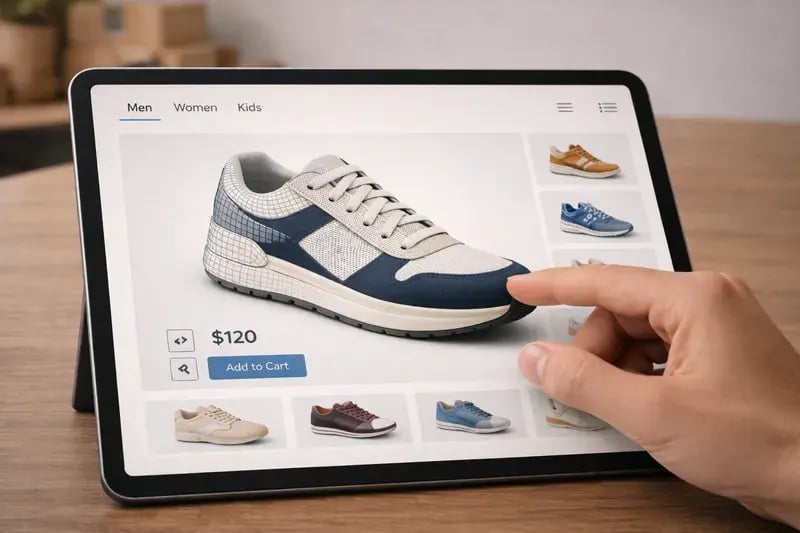
Selling shoes online comes with a unique challenge. Customers cannot feel materials, test comfort, or check sizing accuracy before buying, and this uncertainty directly impacts both conversion rates and return levels.[1]
To succeed, you need more than a standard ecommerce setup. The right features for a shoe ecommerce store help you recreate the in-store experience digitally while improving confidence, engagement, and purchase decisions. These features also play a key role in reducing hesitation throughout the buying journey.
🔑 Key Takeaways
- 3D visualization enhances product understanding and boosts conversion rates by allowing customers to explore shoes in detail.
- Virtual try-on and size tools reduce uncertainty before purchase by helping customers choose the right fit.
- Detailed product information builds trust and improves purchase decisions especially for premium footwear categories.
- Mobile and omnichannel optimization ensures a seamless shopping experience across all customer touchpoints.
- Data-driven features help continuously improve ecommerce performance through insights and iteration.
Why Features Matter in Shoe Ecommerce Performance
Footwear remains one of the most returned product categories in ecommerce. In most cases, these returns are driven by sizing and fit issues rather than product defects, which makes the pre-purchase experience critical.
At the same time, better product experiences have been shown to improve customer engagement and decision-making. When shoppers clearly understand what they are buying, they are more likely to complete their purchase and keep the product.
Features adressing these key issues directly will:
- Reduce uncertainty before purchase
- Improve product understanding
- Increase customer confidence
- Lower return rates
Product Experience Features That Build Confidence
Advanced Product Visualization
Static images are no longer enough to convince customers. 3D models allow users to rotate, zoom, and explore shoes from every angle, which creates a much more immersive and interactive experience.
With tools like 3D viewer of shoes, brands can highlight details such as stitching, sole texture, and finishing quality. These elements are often decisive, especially for customers comparing several models.
In addition, combining multiple angles with high-resolution zoom remains essential. This is particularly important for premium sneakers, boots, and luxury footwear where craftsmanship and materials strongly influence perception.
Realistic Material Rendering
Material perception strongly influences how customers evaluate a product. When shoppers can clearly identify whether a shoe is made of leather, mesh, or knit, they can better anticipate comfort, flexibility, and durability.
Technologies like footwear digitization in 3D make it possible to create highly realistic representations. This level of accuracy reduces doubts and helps customers project how the product will look and feel in real life.
Shoe virtual try-on and Size Tools
Digitally trying on shoes allows customers to visualize how a pair looks on their feet, which is especially useful for fashion sneakers, boots, and lifestyle collections. This type of experience makes the product feel more tangible even through a screen.
Virtual try-on of shoes improves purchase confidence significantly because it helps customers project themselves using the product before buying. It also creates a much more enjoyable shopping journey, where customers feel comforted in their final choice.
When combined with size recommendation tools that analyze customer data, brands can guide shoppers toward the right purchase for their needs. This reduces hesitation and limits the risk of ordering multiple sizes.
Solutions such as virtual try-on of shoes show how digital fitting can improve both engagement and decision accuracy.
Product Information and Trust-Building Features
Clear and Detailed Product Information
Customers need precise and actionable information before purchasing. A detailed sizing guide that includes foot length, width, and brand-specific recommendations helps save time and difficulties related to an ill-fitting pair.
Clear explanations about fit, such as whether a shoe runs narrow, wide, or true to size, allow customers to better anticipate how the product will feel. Adding context about intended use, such as running or everyday wear, also improves relevance. These details are crucial to customers shopping for shoes, where every pair has its space in their everyday use.
User-Generated Content and Social Proof
Shoppers tend to trust other customers more than brand messaging. Reviews and user-generated content therefore play a key role in influencing final purchase decisions.
Photos of worn sneakers, feedback on sizing accuracy, and comments about comfort after several uses provide real-world insights. This content helps customers feel validated in their choice by relating their shopping experience to other customers.
Transparency Reduces Returns
When customers clearly understand what they are buying, they are less likely to return products. Transparency across product pages improves satisfaction and builds long-term trust.
This also helps brands reduce operational costs related to returns and improve overall customer loyalty. A well-informed customer is more likely to become a repeat buyer.
Mobile, Omnichannel and Conversion Optimization Features
Mobile-First and Seamless Experience
A large share of ecommerce traffic now comes from mobile devices, which means your store must be designed with mobile usage in mind. A smooth mobile experience is no longer optional but expected.
Fast loading times, intuitive navigation, and responsive design help keep users engaged. Even small friction points on mobile can lead to drop-offs, especially during product exploration. Make sure your 3D shoe turnaround or virtual try-on is seamlessly functional and allows shoppers to experience your store properly from the comfort of their home.
Omnichannel Consistency
If you own a physical store, customers will often choose to have both online and in-store experiences before making a purchase in order to validate their choice or accurately choose a size. They may discover a product online and try it in-store, or the opposite.
Your ecommerce features should support this behavior by enabling actions such as checking in-store availability or saving favorites across devices. This creates continuity in the customer journey.
Consistency in product visuals, pricing, and sizing information across all channels builds trust. It also avoids confusion and reinforces brand reliability.
Conversion and Performance Optimization
A simplified checkout process with multiple payment options helps reduce cart abandonment. The easier it is to complete a purchase, the higher the chances of immediate conversion.
Personalized product recommendations based on browsing behavior can increase engagement and encourage discovery. This is particularly useful for showcasing similar sneakers or complementary items.
Stock visibility and subtle urgency signals can also influence decision-making. When used correctly, they help customers act without feeling pressured or leading to losing interest.
| Feature | Impact |
|---|---|
| 3D visualization | Improves engagement and product understanding |
| Virtual shoe fitting | Supports better purchase decisions |
| Size recommendation | Enhances sizing accuracy |
| Mobile optimization | Delivers smoother user experience |
Conclusion
Choosing the right features for a shoe ecommerce store has a direct impact on your business performance. Each feature contributes to reducing uncertainty and improving customer confidence throughout the buying journey.
By combining strong product visualization, accurate sizing tools, and a seamless omnichannel experience, you create a shopping journey that feels closer to trying shoes in a physical store. At the same time, you benefit from the scalability and efficiency of digital commerce.

Fittingbox Footwear
Fittingbox Footwear is a dedicated business unit of Fittingbox, specialized in 3D and augmented reality solutions for the footwear industry. It offers ultrarealistic 3D digitization, immersive virtual try-on, and flexible integration — ranging from plug-and-play tools to fully customizable implementations.